Taste doesn't type
FLAM has no prompt box and never will. A director's judgement works by selecting, arranging and refusing, and none of that survives being typed into a field. So the house asks for choices, and puts control on a picture rather than on a sentence.
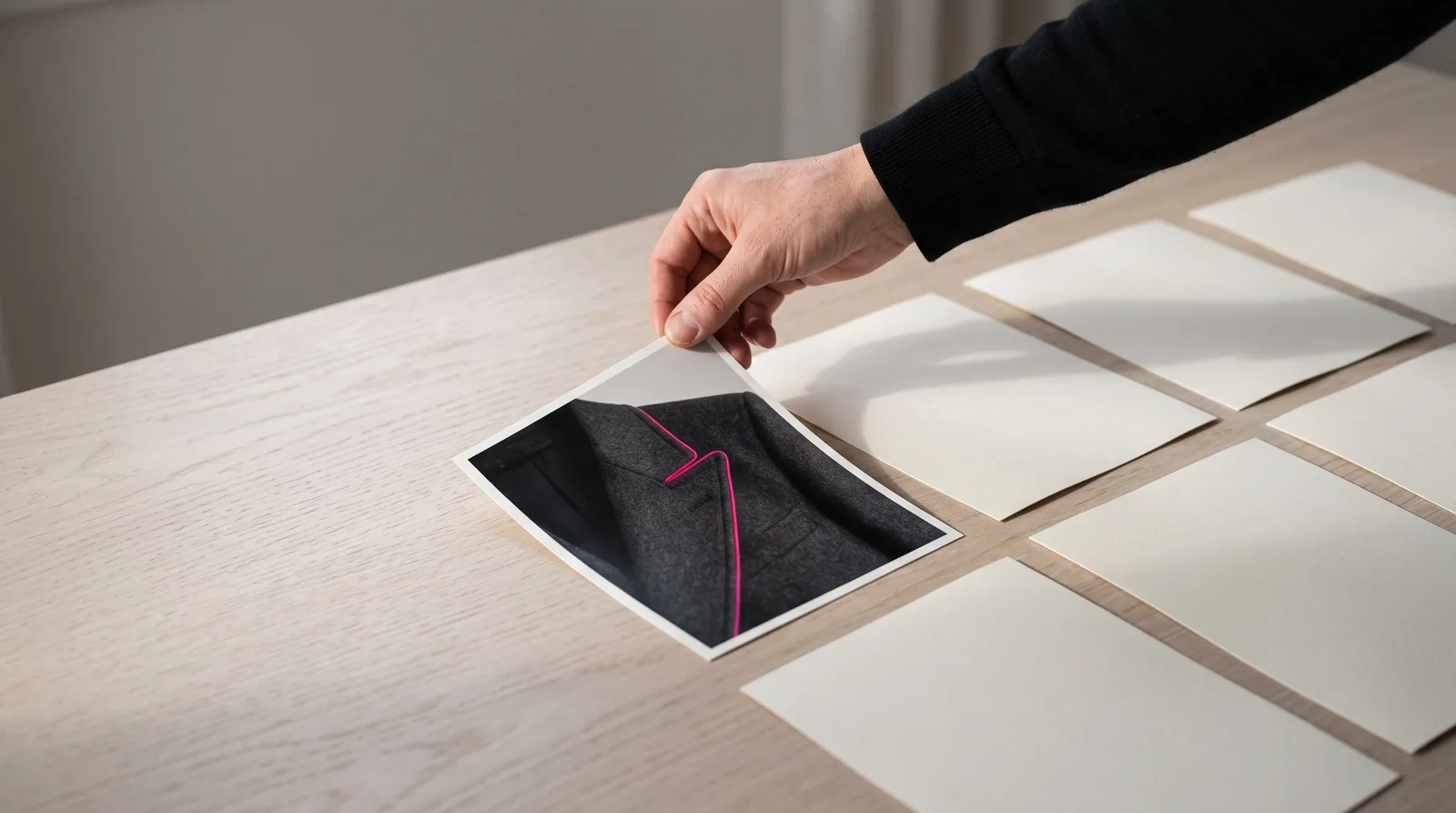
The house has no prompt box and never will. A creative director's judgement is not verbal. It lifts one print off a table of twenty, turns the rest face down, and does it in about a second. A text field asks for that same judgement in sentences, then grades the sentences. So the house asks for choices instead.

I have watched a lot of directors work. The good ones do not look like they are working. A contact sheet goes down on the table, a hand moves across it, six prints get turned face down without comment and one gets lifted. Ask why that one and you get a sentence that is not really an explanation. The shoulder is right. The judgement did not arrive in words and it does not leave in them either.
Now put that person in front of a text field. It wants the same judgement translated: comma-separated, in the vocabulary of a model whose documentation they have never read, with the tacit knowledge that the words which matter are not the ones describing the picture but the ones weighted heavily in somebody's training set. It is a competence test in a subject nobody hired them for, and the people who score highest on it are frequently not the ones with the best eye.
What a director actually does
Selecting is picking which of the things in front of you is the one, and it requires the things to be in front of you. So the house puts a board of models and a shortlist of grounds on the screen instead of a field where you type a hair colour. Choosing between twelve real options and summoning one from nothing are different acts, and only the first is the one directors are trained in.
Arranging is deciding what follows what. A collection is a sequence, not a bag of garments, and the sequence carries the argument of the season: the look you open on, the piece that turns the mood, the thing you close with. So the house works in collections and running orders rather than one image at a time.
Refusing is the one nobody builds for, and it is most of the job. A director says no far more often than yes. Not this print. Not this crop. Not that shoe with that hem. Anything that only knows how to make more things makes every no expensive, because each one costs another wait and another spend. So the house makes no cheap: keep the frame you approve, drop the ones you don't, develop again from what you kept.
What the house asks for instead
Cast the models. Hang the collection. Choose the ground. Then the part that decides everything else: one reference frame is developed and put in front of you, and you either approve it or you do not. Approve it and it is locked, and every frame after it is built from it. The same face, the same key, the same weight in the coat. Refuse it and you change one thing and look again, and it has cost you a single frame.
That is the locked frame, and it is the closest the house comes to an argument. You are not adjusting adjectives and hoping. You are approving a picture, then saying what varies from it.

Underneath there is a great deal of prompt. Years of photographic language, camera and lens registers tuned one frame at a time, realism clauses that keep skin reading as skin and stop a wool coat hanging like a nylon one. That work is real and it is ours. It is also the last thing a creative director should be asked to maintain, which is why you will never see it.
If the house has no ground that suits your collection, you cannot describe one into existence. A prompt box would let you try, and now and again you would succeed, and the other nine times you would spend an afternoon finding out that you had not. We would rather add the ground.
The part that is genuinely a machine's
Automation belongs where the work repeats and the judgement has already been made. Forty variations of a locked frame is not a creative act. It is a queue. So the house runs it as one: many frames developing at once, each resumable, each interruptible, and a note when the set is done. Nobody should be paid to watch a progress bar.
A season's intake has the same shape. Four hundred photographs landing in a folder is not a creative problem. Sorting them, pairing the front and back of one shirt, noticing which pieces were already packshotted in March: that is work a machine should have finished before you opened the folder, and then shown you for approval.
The same door is open to software. A develop you start from your own system is the develop a director starts in the studio: submit it, take the id, and listen on the socket instead of polling for four minutes. The choices are the interface either way. There is nothing to phrase, so there is nothing for an agent to phrase badly. An MCP server would make that door the obvious one and it is designed, not built. The API docs mark which half answers today.
Where this leaves the eye
Exactly where it was. What changes is how much of the day goes on things that are not judgement: the retouch queue, the reshoot because a model was unavailable in October, the four hundred packshots that all have to look like one afternoon. That volume problem is on the rail. Why the house ships a shortlist of grounds rather than a colour picker is the set is a decision. The docs are short on purpose.
A director who spends the afternoon phrasing is not a better director by the evening. Give them the table, the prints and the hand. That part has never needed improving.
Questions
- Why does FLAM have no prompt box?
- Because a creative director's skill is not verbal. It is selection, arrangement and refusal, done by eye and at speed against a hundred references they already carry. A prompt box asks for that in a paragraph, then grades the paragraph. The house asks for choices instead: the model, the pieces, the ground, one reference frame to approve, then the variations. The photographic language underneath is the house's to maintain, and you never see it.
- Does removing the prompt box mean less control?
- It moves control to where a director can actually exercise it. You cannot reliably steer a picture by adjusting adjectives. You can steer it by locking an approved reference frame and choosing what varies from it. Every lookbook is built from a frame you signed off on, so control is exercised on a picture rather than on a sentence.
- Who is FLAM for?
- Fashion brands, and the creative directors, studio managers and e-commerce leads who work with them. Anyone responsible for turning a season of physical garments into professional imagery. It assumes you know what a good frame looks like. It does not assume you know or care how a diffusion model reads a comma.
- What does FLAM cost to run?
- Developing frames is metered in tokens: 9, 13 or 19 for 1K, 2K and 4K, stated before you commit and identical to what settles afterwards. Anything pre-made, a model or a preset, is bought once with real money at a shown price. Tokens never buy a pre-made thing, and money never buys a develop.