The fit belongs to the piece
A flatlay never says whether a shirt is meant to hang off the shoulder or sit on it, or who it is cut for. Both facts now belong to the piece: read free from the photograph at upload, written once, carried into every frame, with a magenta mark only on the words the house had to guess.
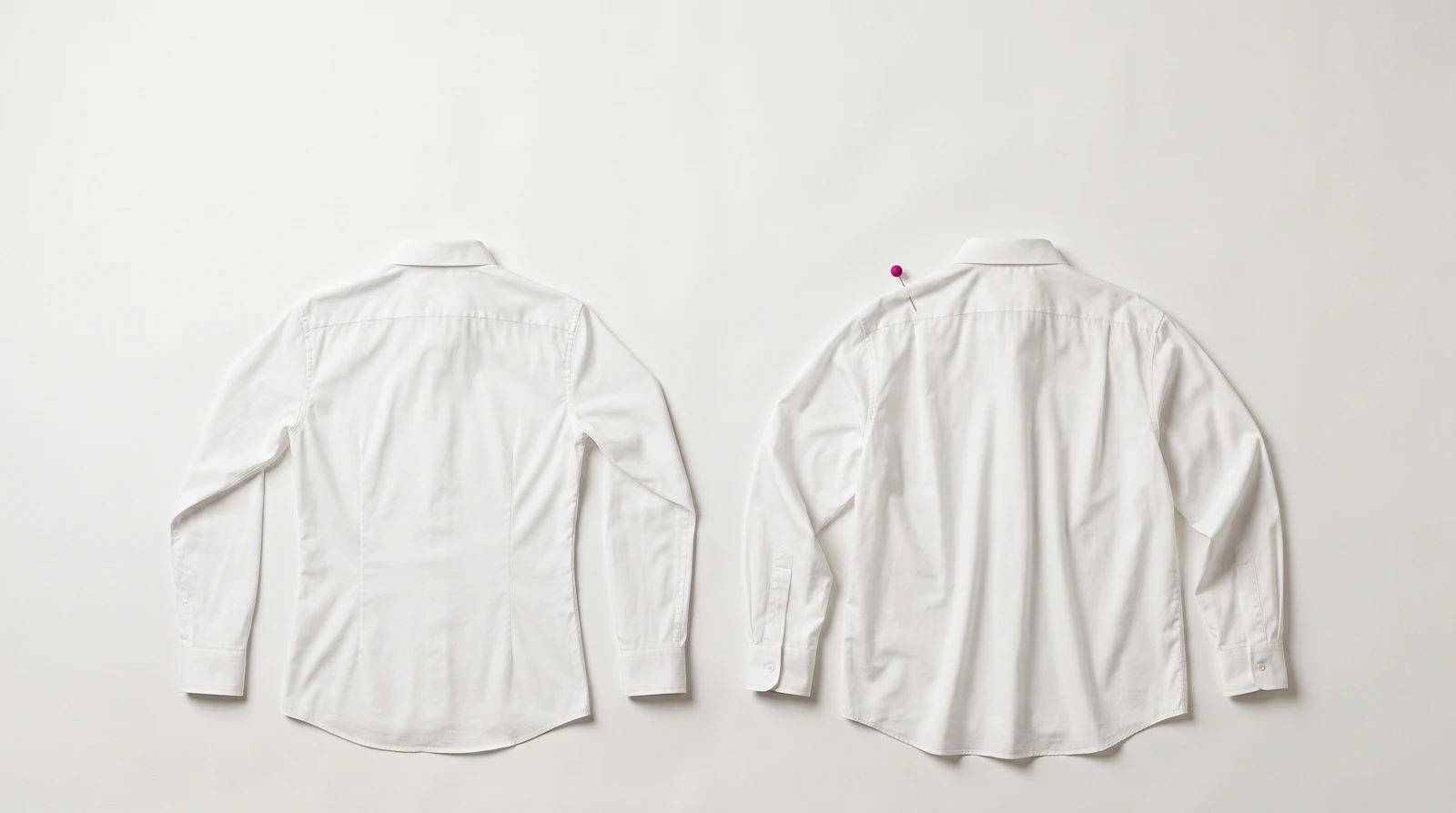
How a garment is worn, and who it is cut for, now belong to the piece itself. The house reads both off the photograph as it lands, free, in the same read that already names it. Say it once, or never say it, and every frame that piece appears in carries the answer.
Why did I keep answering the same question?
Because the answer used to live on the job, and the job forgot it. Try-on took the fit as a setting on one submission. You picked oversized for a boxy tee, the frame developed, and the fact died with it. The next time that tee was used, the house asked again. The lookbook never asked at all.
That second gap was the expensive one. The lookbook is exactly where a garment meets a model across a whole collection, and its instructions said nothing about how the garment is worn. So the model decided, per frame, and drifted. One lane took a fit but never a piece's name. The other took a name but never a fit. Each held half a sentence.
And nothing anywhere said who a garment was cut for. A menswear label's jackets were described to the model as nothing in particular.
What do I see when I open a piece now?
The card already says worn oversized · cut for women before it asks you anything. You fill in no form. There is no button, and nothing new is charged: the read that already names every upload now returns the cut in the same breath, for the same zero tokens.
On screen the two captions are "Worn" and "Cut for". The values are plain words: as it falls, fitted, true to size, loose, oversized. For the cut: not said, women, men, unisex. An unread piece opens on "not said", because a fact nobody established should not sit in a control that looks answered.
Why is only one word marked?
Because marking every piece is the same as marking none. A fitted blazer and an oversized tee have unmistakable silhouettes on a flatlay, and the house states them plainly, with no mark at all.
The middle of the axis is honestly harder. A shirt cut with two extra inches of ease is true to size to one buyer and loose to another, and on a flatlay it is one photograph. So every middle read carries the magenta hairline. So does anything read off a piece photographed on a body, because what you can see there may be the stylist's choice rather than the garment's cut. The mark is spent on the guess and nowhere else. The rationing is the feature.
Why will it never guess unisex?
Because unisex is not in the photograph. Button side, shoulder proportion, neckline, waist shaping and dart placement are visible facts on a flatlay. Unisex is a merchandising decision your team made, and no photograph contains it. A house that guesses unisex is guessing at a spreadsheet it has never seen.
So the read is only ever offered two words. Unisex is yours alone, entered by correction, never put in your mouth. In the code this is a type, not a comment: the read's instructions and the check that clamps its answer share one list, so the rule cannot be broken by editing one of them.
Why not relaxed, or cropped?
Because a photograph can only tell so much apart. We considered three more values and refused them. Relaxed is loose under a second name. A four-value axis is already at the edge of what a photograph can tell apart, and a fifth value you cannot tell from its neighbour makes both worse. A separate true to size says nothing the middle of the axis does not already say. And cropped is a length, not a fit. A cropped tee can be fitted or oversized, and the two facts are independent. Length belongs to the piece's name, cropped white tee, where it already rides.
What does the model actually read?
One sentence, the one that already names the piece: the cropped white tee shown in reference image 2, a men's cut worn oversized. A piece with neither fact adds no words at all, and that is what makes it safe to switch on for every look in the house at once. A look of unread pieces compiles exactly what it compiled yesterday.
Because the instruction is now in the brief, the house's own read grades against it for free. A frame briefed oversized that comes back skin-tight ignored what it was told, and the house says so.
Two more places it lands. Packshots arrive pre-answered: the ghost form is built for the body the garment is cut for, without you setting anything. And you can just say it. Tell the chat the linen shirt is meant to be worn loose, and it is written onto the piece. You are not sent to find a screen.
Can I still put a men's jacket on a female model?
Yes, and nothing will stop you or warn you. That pairing is a real styling choice and it develops. Who a piece is cut for is guidance to the model, never a refusal. There is deliberately no validation and no confirm dialog anywhere in this.
What does it not know?
It does not read size. An XS and an XXL of the same tee are the same photograph without something in frame for scale. A real size lives in your PIM.
It does not read fabric. Whether a loose linen shirt falls or a loose neoprene one stands is a property of the material, not of the fit.
It will not catch a one-notch miss. The house's read owns briefed oversized and developed skin-tight. It does not own briefed loose and developed true to size.
It does not backfill. Every piece already in your library stays unread and develops exactly as it does today. Set the cut when you next open one, or leave it.
And a per-job override never writes back to the piece. If you set try-on to fitted for one shot because the stylist belted it, that is the shot's styling, not the garment's cut. A silent write-back would corrupt the piece from a job you thought was disposable.
Related
The fit was always the half of the sentence nobody wrote down. The piece had a name, the job had a fit, and the two never met. Now they are one sentence, on the piece, said once.
- Lane by lane, in the docs: how a piece's cut travels.
- The same half-sentence problem, one wave earlier: no prop is invented.
- What shipped, and when: /changelog#how-its-worn.
Questions
- How does FLAM know whether a garment is oversized or fitted?
- The photograph is read as it lands, inside the same free read that names the piece. A fitted blazer and an oversized tee have unmistakable silhouettes on a flatlay, so those are stated plainly. A read in the middle of the axis is marked as a guess with a magenta hairline, and correcting it is one tap.
- Why does an AI shoot put the same shirt on the model differently in every frame?
- Because nothing in the instructions said how the shirt is worn, so the model decided per frame and drifted. The fix is writing the fit on the piece itself. The sentence that names the piece now carries it, in every frame that piece appears in: a men's cut worn oversized.
- Can a men's jacket go on a female model?
- Yes, and it develops without a warning. Who a piece is cut for is guidance to the model, never a refusal. A men's jacket on a female model is a styling choice, and the house does not gate styling choices.
- Does reading the fit cost anything?
- No. The read happens inside the call that already names every upload, so nothing new is charged. There is no button either. Open the piece and the answer is already on the card.
- Will pieces already in my library get a fit?
- No. There is no backfill. Existing pieces stay unread and develop exactly as they do today. Set the cut when you next open one, or leave it.